LINGUISTIC
INTELLIGENCE
1. What Is It?
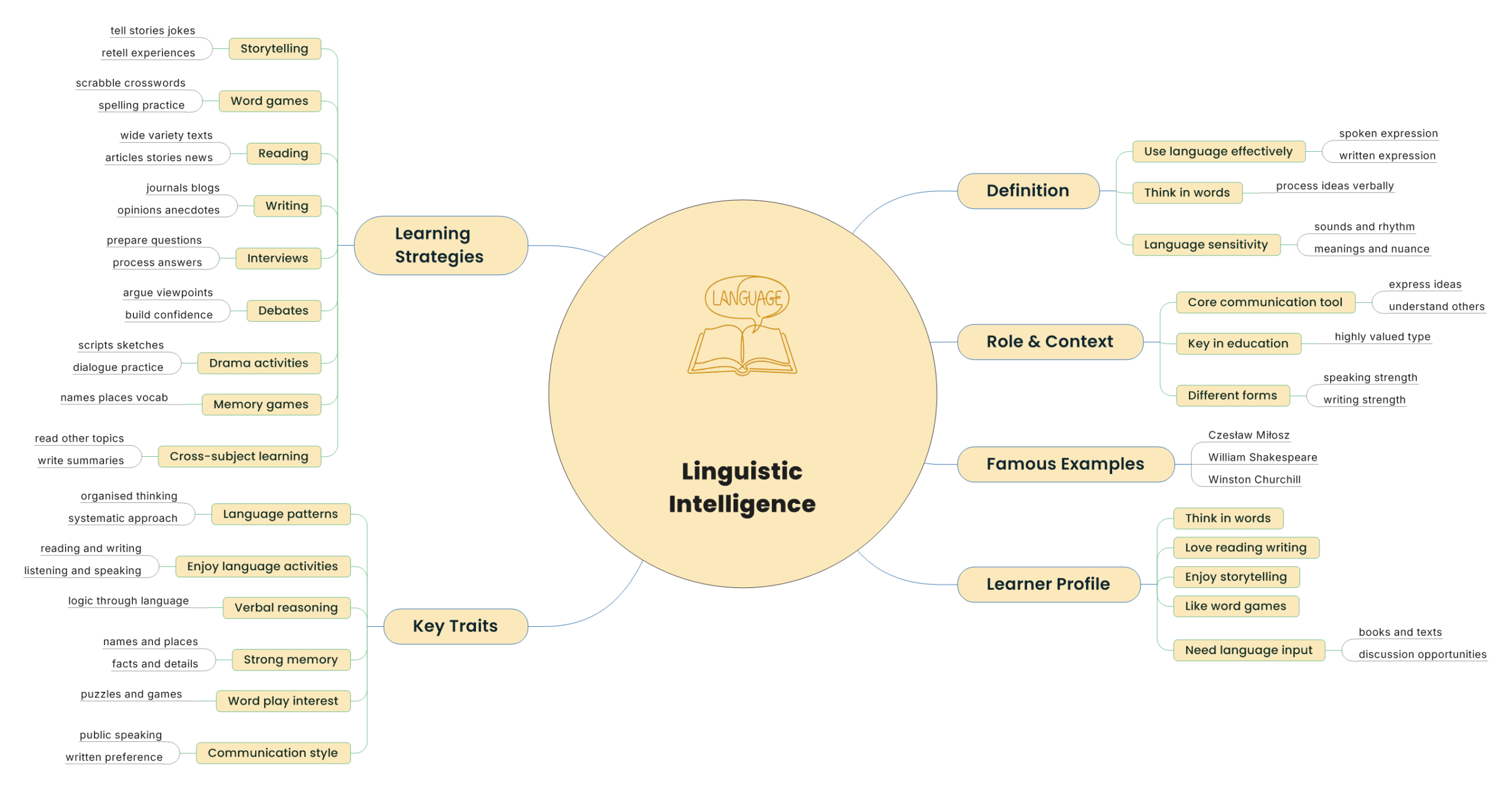
Linguistic intelligence is the capacity to use language effectively — both in spoken and written form — to express ideas, understand others, and make sense of the world. People with well-developed linguistic intelligence think in words. They are drawn to reading, writing, storytelling, and word games, and they tend to have a natural sensitivity to the sounds, meanings, and rhythms of language.
This intelligence is at the heart of how we communicate, and it plays a central role in language learning. It is particularly well developed in writers, journalists, poets, lawyers, and public speakers. In Howard Gardner’s framework, linguistic intelligence — together with logical-mathematical intelligence — has traditionally been the most valued type in formal education. However, it is important to remember that strong linguistic intelligence can manifest in many different ways: some people are brilliant speakers and debaters, while others express themselves best through the written word.
Famous representative: Czesław Miłosz
2. Key Traits
A person with strong linguistic intelligence is likely to display many of the following characteristics. They are sensitive to patterns in language and tend to be well organised and systematic in their thinking. They enjoy listening, reading, and writing, and they have a natural ability to reason through language. Spelling tends to come easily to them, and they are drawn to word games, puzzles, and verbal play. They remember details well — names, places, and facts tend to stick. They may be effective public speakers and skilled debaters, though some linguistically oriented individuals actually prefer written communication over speaking aloud.
At a glance, linguistic learners think in words. They love reading, writing, storytelling, and word games. They thrive when they have access to books, journals, writing materials, and opportunities for dialogue, discussion, and debate.
How to Use It in the Learning Process
Linguistic intelligence is, in many ways, the natural ally of English language learning, but it still benefits from deliberate activation. Here are practical strategies for learners and teachers:
- Tell stories and jokes in English. Retell personal experiences — your last holiday, a funny incident, a business trip. Storytelling practises fluency, narrative structure, and natural intonation all at once.
- Play word games such as Scrabble, crosswords, or spelling bees. These activities build vocabulary and reinforce spelling in an engaging way.
- Read widely and often — articles, short stories, graded readers, news reports. The more varied the reading material, the richer the language input.
- Write regularly. Keep a journal, write short anecdotes or opinion pieces, contribute to a class newsletter, or start a blog. Writing consolidates what has been learned and develops a personal voice.
- Conduct interviews — with your teacher, fellow students, or even people outside the classroom. Preparing questions and processing answers is excellent practice for both speaking and listening.
- Engage in debates and discussions. Arguing a point of view — whether you agree with it or not — strengthens argumentation skills, expands vocabulary, and builds confidence.
- Create sketches and short scripts. Drama-based activities give linguistic learners a creative outlet while practising dialogue, register, and pronunciation.
- Play memory games involving names, places, and vocabulary sets. Linguistic learners often retain information best when it is embedded in a verbal context.
- Combine reading and writing with other subject areas. For instance, read an article about science or history in English and then write a summary or reflection. This deepens both content knowledge and language skills.