VISUAL-SPATIAL
INTELLIGENCE
1. What Is It?
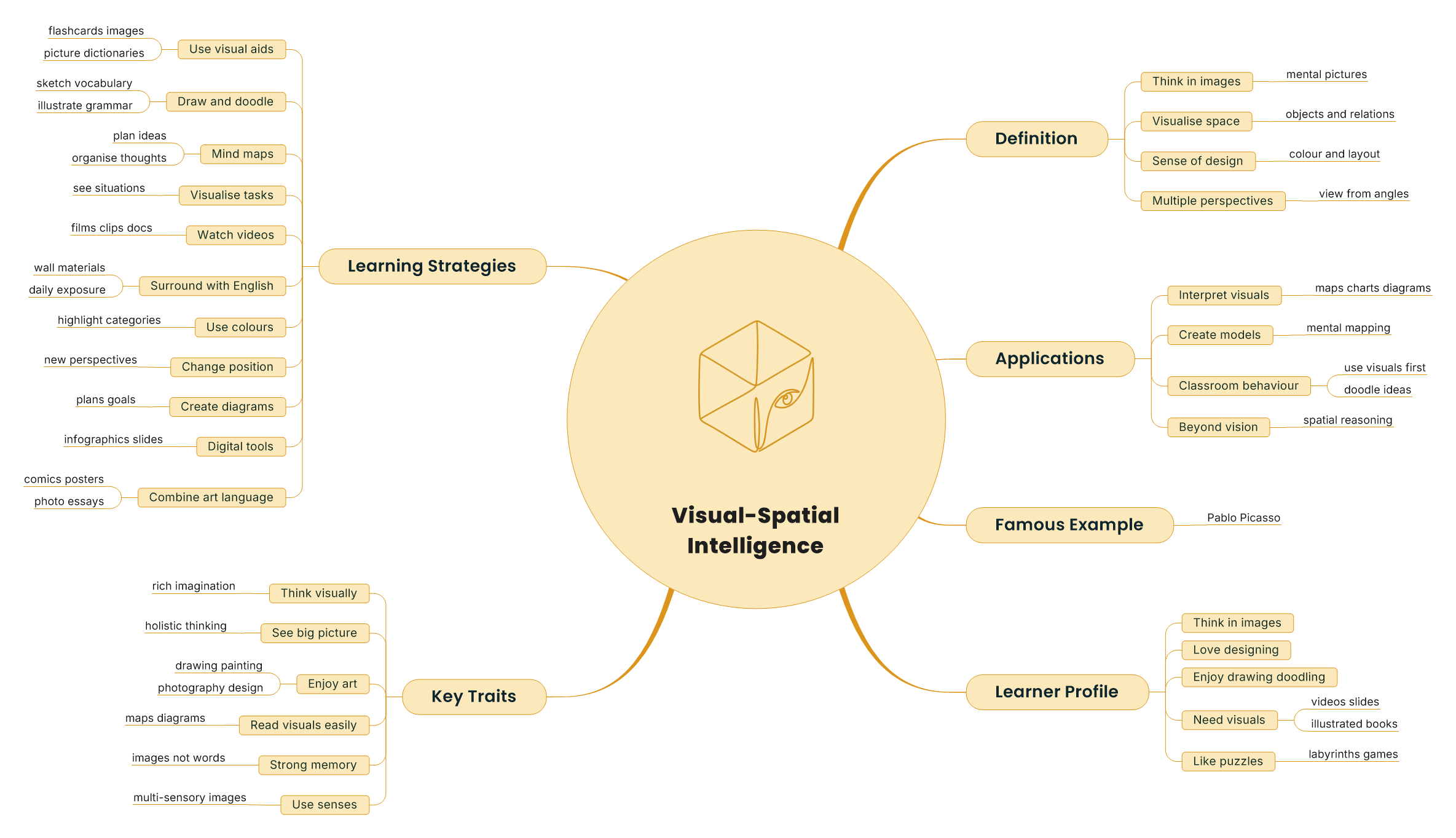
Visual-spatial intelligence is the ability to perceive, transform, and recreate visual and spatial information. People with strong visual-spatial intelligence think in images. They form vivid mental pictures, have a keen sense of colour and design, and can easily visualise objects, spaces, and relationships from different perspectives.
This intelligence makes it possible for people to interpret maps, charts, and diagrams with ease, and to create mental models of the world around them. It is well developed in architects, sculptors, engineers, navigators, photographers, and designers. In the classroom, students with strong spatial intelligence are the ones who turn first to the graphs, charts, and pictures in their textbooks, who like to “web” their ideas before writing, and who fill the margins of their notebooks with intricate doodles and patterns.
Importantly, visual-spatial intelligence is not limited to the visual modality alone — it can also be exercised to a high level by individuals who are visually impaired, through spatial reasoning and mental mapping.
Famous representative: Pablo Picasso
2. Key Traits
A person with strong visual-spatial intelligence thinks in images and creates rich mental representations of reality. They naturally use metaphors and have a strong sense of the whole — they see the big picture. They enjoy art in all its forms: drawing, painting, sculpture, and photography. They read maps, diagrams, and charts with ease and remember information as images rather than words. They have a good sense of colour and use all their senses when forming a mental picture of something.
At a glance, visual-spatial learners think in images. They love designing, drawing, visualising, and doodling. They need access to art, video, slides, imagination games, labyrinths, puzzles, and richly illustrated books.
How to Use It in the Learning Process
Visual-spatial intelligence offers a rich set of strategies for English language learning. For learners who think in pictures, the key is to make language visible. Here are practical ideas:
- Use visual aids and illustrations while learning. Flashcards with images, picture dictionaries, and illustrated grammar guides all speak directly to the spatial learner.
- Doodle and draw at every opportunity. Sketching vocabulary items, drawing scenes from a story, or illustrating grammar rules can make abstract concepts concrete and memorable.
- Create and use mind maps and charts. Mind-mapping is a powerful tool for brainstorming vocabulary, planning essays, and organising ideas before speaking or writing.
- Visualise problems and solutions. When preparing for a discussion or a writing task, encourage spatial learners to “see” the situation in their mind’s eye before putting it into words.
- Watch films, video clips, and documentaries in English. Visual learners absorb language naturally through moving images combined with spoken English.
- Pin materials to walls and fridges. Surround yourself with English — vocabulary lists, grammar charts, inspirational quotes — placed where you will see them every day (peripheral stimuli).
- Use colour coding. Highlight different parts of speech, tenses, or vocabulary categories in different colours. This taps directly into the spatial learner’s sensitivity to colour.
- Change your position in the room to get a different perspective. Moving to a different seat, standing up, or working in a new space can spark fresh ideas.
- Create diagrams to represent plans, goals, and learning targets. A visual roadmap of your English learning journey can be both motivating and clarifying.
- Use computer graphics and digital design tools to create presentations, infographics, or visual summaries of what you have learned.
- Combine art with language learning. Draw a comic strip to practise narrative tenses, design a poster for a class project, or create a photo essay with English captions.