
MUSICAL
INTELLIGENCE
1. What Is It?
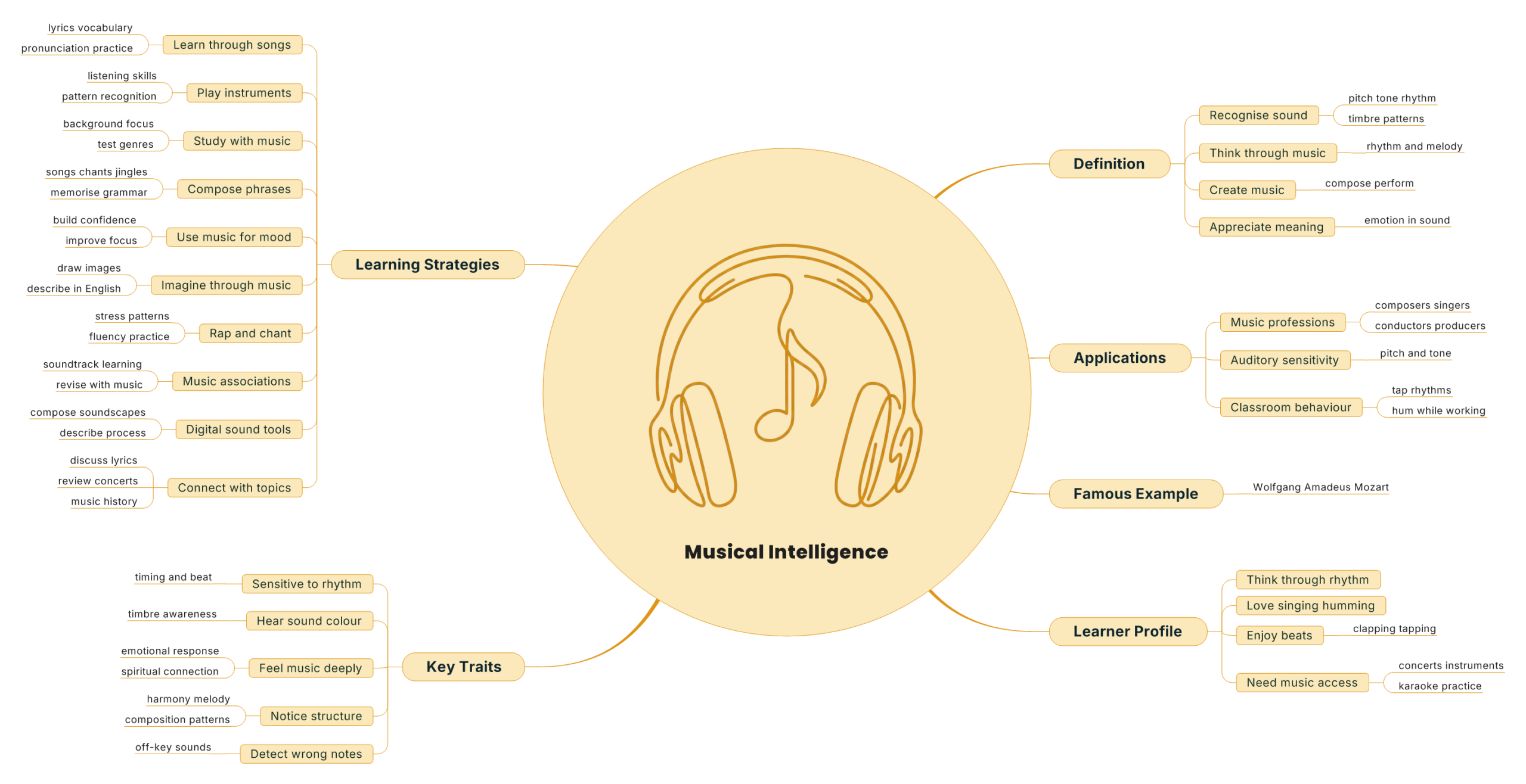
Musical intelligence is the capacity to recognise, create, and appreciate musical pitches, tones, rhythms, and timbres. People with strong musical intelligence think through rhythm and melody — they are sensitive to the sounds around them and naturally attuned to the emotional power of music.
This intelligence encompasses the ability to compose, perform, and deeply appreciate music, as well as to understand the meanings conveyed through sound. Auditory perception is important for developing sensitivity to pitch and tone, though rhythm can be understood and appreciated independently of hearing. Musical intelligence is well developed in composers, instrumentalists, conductors, singers, and music producers. In the classroom, these are the students who seem particularly drawn to the birds singing outside the window, who constantly tap out rhythms on the desk with their pencils, or who hum quietly while working.
Famous representative: Wolfgang Amadeus Mozart
2. Key Traits
A person with strong musical intelligence is sensitive to rhythm, tonality, and the timbre (colour) of sounds. They respond strongly to the emotional content of music and can appreciate its complex structure — harmony, melody, and composition. They may have a deep, sometimes spiritual, connection to music. They often notice when a note is off-key and have a natural sense of timing and beat.
At a glance, musical learners think through rhythm and melody. They love singing, whistling, humming, tapping out beats, clapping, and listening to music. They need opportunities to sing along, attend concerts, play instruments, and explore music in all its forms — including karaoke.
How to Use It in the Learning Process
Music and language share deep structural connections — rhythm, intonation, stress, and phrasing. Musical intelligence can be a remarkably powerful tool for learning English. Here are practical strategies:
- Learn through songs. Listening to, singing along with, and analysing English-language songs is one of the most effective and enjoyable ways to absorb vocabulary, grammar, and natural pronunciation.
- Play a musical instrument — or start learning one. The discipline of musical practice develops the same listening and pattern-recognition skills that support language acquisition.
- Study with background music. Baroque music, in particular, has been shown to create an optimal state for focused learning. Experiment with different genres to find what works best for you.
- Compose simple songs, chants, or advertising jingles in English. Turning vocabulary lists or grammar rules into musical phrases makes them far more memorable.
- Use music to control your mood and energy. Play upbeat music before a speaking activity to build confidence, or listen to calm music before a reading or writing task to improve focus.
- Listen to music and draw or imagine the images it evokes — then describe those images in English. This combines musical and spatial intelligence with language practice.
- Practise through rapping, chanting, and choral reading. Rhythm-based spoken activities are excellent for improving pronunciation, stress patterns, and fluency.
- Associate pieces of music with specific vocabulary or grammar points. Creating a personal “soundtrack” for your learning makes revision more engaging and effective.
- Use digital tools to compose music or create soundscapes — and describe your creative process in English.
- Connect music with other subjects and topics. Discuss the lyrics of a song, write a review of a concert, or explore the history of a musical genre — all in English.