
LOGICAL-MATHEMATICAL
INTELLIGENCE
1. What Is It?
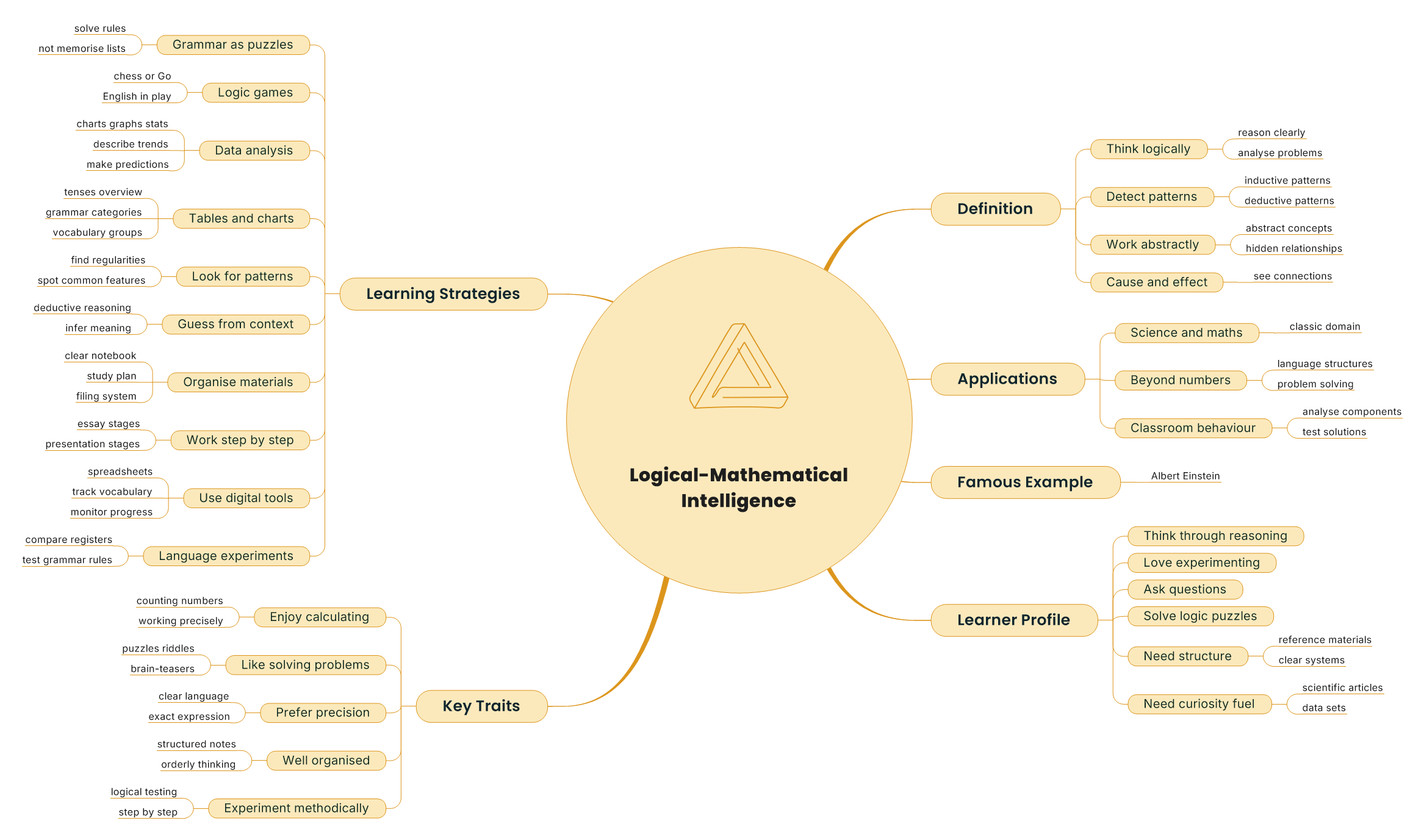
Logical-mathematical intelligence is the ability to think logically, detect patterns, reason deductively, and work with abstract concepts. People with strong logical-mathematical intelligence think through reasoning — they analyse, categorise, and look for cause-and-effect relationships in everything around them.
This intelligence is most commonly associated with scientific and mathematical thinking, but its applications extend far beyond numbers. It enables individuals to identify inductive and deductive patterns — including patterns in language structures — and to appreciate abstract relationships. It is particularly well developed in mathematicians, scientists, engineers, detectives, lawyers, and accountants.
In the classroom, students with strong logical-mathematical intelligence are the ones who carefully analyse the components of a problem — whether personal or school-related — before systematically testing possible solutions.
Famous representative: Albert Einstein
2. Key Traits
A person with strong logical-mathematical intelligence typically enjoys counting, calculating, and thinking abstractly. They apply logical structures to their thinking and like solving problems — puzzles, riddles, and brain-teasers are particularly appealing. They prefer precision in language and expression, and they like to be well organised. They enjoy experimenting in a methodical, logical way, and they tend to take orderly, well-structured notes. Their approach to new material is systematic and step-by-step.
At a glance, logical-mathematical learners think through reasoning. They love experimenting, asking questions, and solving logic puzzles. They need things to investigate and reflect on, as well as access to materials that satisfy their curiosity — scientific articles, data sets, and structured reference materials.
How to Use It in the Learning Process
Although language learning might seem to be primarily a linguistic domain, logical-mathematical intelligence offers powerful tools for mastering English — especially its structures and systems. Here are practical strategies:
- Simulate problems and find ways of solving them. Present grammar rules as puzzles to be cracked rather than lists to be memorised.
- Play games that require logical or mathematical thinking, such as chess, Go, or strategy-based board games — ideally with English as the language of play.
- Analyse and interpret data. Work with charts, graphs, and statistics in English. Read data-driven articles and practise describing trends and making predictions.
- Build tables and charts for tenses, grammar structures, and vocabulary categories. Organising language visually and logically helps this type of learner see the system behind the language.
- Reason and look for patterns. When encountering new vocabulary or grammar, encourage learners to look for regularities: What do these words have in common? What rule governs this structure?
- Try to guess the meaning of unknown words from context. This activates deductive reasoning — a core strength of logical-mathematical learners.
- Organise your learning space and materials. A well-structured notebook, a clear study plan, and a logical filing system for vocabulary and grammar notes can make a real difference.
- Work step by step. Break complex tasks (such as writing an essay or preparing a presentation) into clearly defined stages.
- Use spreadsheets and digital tools for tracking vocabulary, monitoring progress, or organising revision schedules.
- Carry out practical experiments with language — for example, compare how the same idea is expressed across different registers or test whether a grammar rule applies in every context.