
BODILY-KINESTHETIC
INTELLIGENCE
1. What Is It?
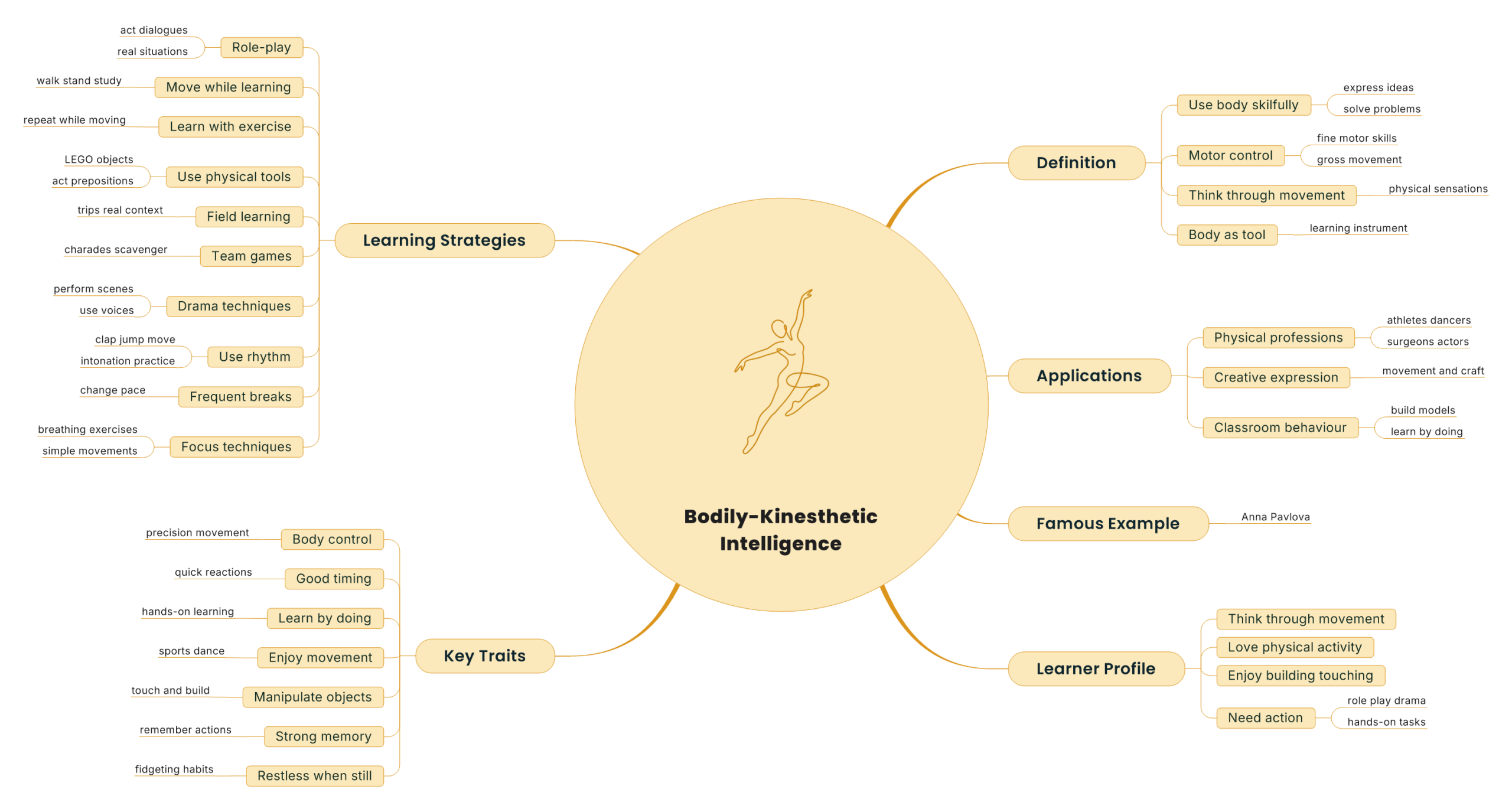
Bodily-kinesthetic intelligence is the ability to use one’s body skilfully to express ideas, create products, or solve problems. It involves both fine motor control (working with hands and fingers) and gross motor coordination (whole-body movement). People with strong bodily-kinesthetic intelligence think through physical sensations and movement — their bodies are, in a very real sense, instruments of learning.
This intelligence challenges the popular belief that mental and physical activity are unrelated. In fact, it allows individuals to use all or part of their body with remarkable precision and expressiveness. It is well developed in athletes, surgeons, dancers, choreographers, actors, and craftspeople. In the classroom, these are the students who relish gym class and school dances, who prefer to carry out class projects by building models rather than writing reports, and who learn best when they can move, touch, and do.
Famous representative: Anna Pavlova
2. Key Traits
A person with strong bodily-kinesthetic intelligence has exceptional control over their body and a natural ability to handle objects with precision. They have a good sense of timing and tend to have quick, automatic physical reactions. They are highly sensitive to their physical environment and learn best through movement and hands-on experience. They enjoy sports, dance, and physical activities, and they like to touch and manipulate objects. They are often manually and technically skilled, with a talent for crafts and practical work. They tend to remember what was done rather than what was said or shown, and they may fidget or become restless if forced to sit still for too long. You might notice them playing with objects — a pen, a paperclip, a rubber band — while listening.
At a glance, bodily-kinesthetic learners think through physical sensations. They love dancing, running, jumping, building, touching, and gesturing. They need role-playing, drama, physical activity, sports, hands-on experiments, and tactile experiences.
How to Use It in the Learning Process
For kinesthetic learners, the English classroom needs to be a place of movement and action. Sitting still and studying from a textbook is rarely the most effective route. Here are practical strategies:
- Role-play what you have learned. Act out dialogues, scenes from stories, or real-life situations such as ordering food, checking into a hotel, or negotiating a deal.
- Move around when you learn. Walk around the room, go for a stroll, or stand up while reviewing vocabulary. Physical movement helps kinesthetic learners process and retain information.
- Repeat words and phrases while jogging, swimming, or exercising. Pairing language with physical activity creates strong memory associations.
- Use building blocks, LEGO, or other physical tools and toys to enhance learning. For example, build a structure and describe it in English, or use physical objects to act out prepositions of place.
- Go on excursions and field trips. Learning English in real-world settings — a museum, a market, a park — brings language to life.
- Take part in team games and group activities conducted in English. Games that require physical action alongside language use (such as charades or scavenger hunts) are ideal.
- Use drama techniques. Act out scenes, perform sketches, and experiment with different characters and voices. This builds confidence, improves pronunciation, and develops fluency.
- Snap your fingers, clap, stamp, jump, and move to the rhythm of English. Physical engagement with the sounds of the language helps with intonation and stress patterns.
- Make sure to include plenty of breaks and changes of pace. Kinesthetic learners need frequent transitions between activities to stay focused and energised.
- Use martial arts-inspired focus techniques (such as controlled breathing or simple physical exercises) to centre attention before a concentrated study session.