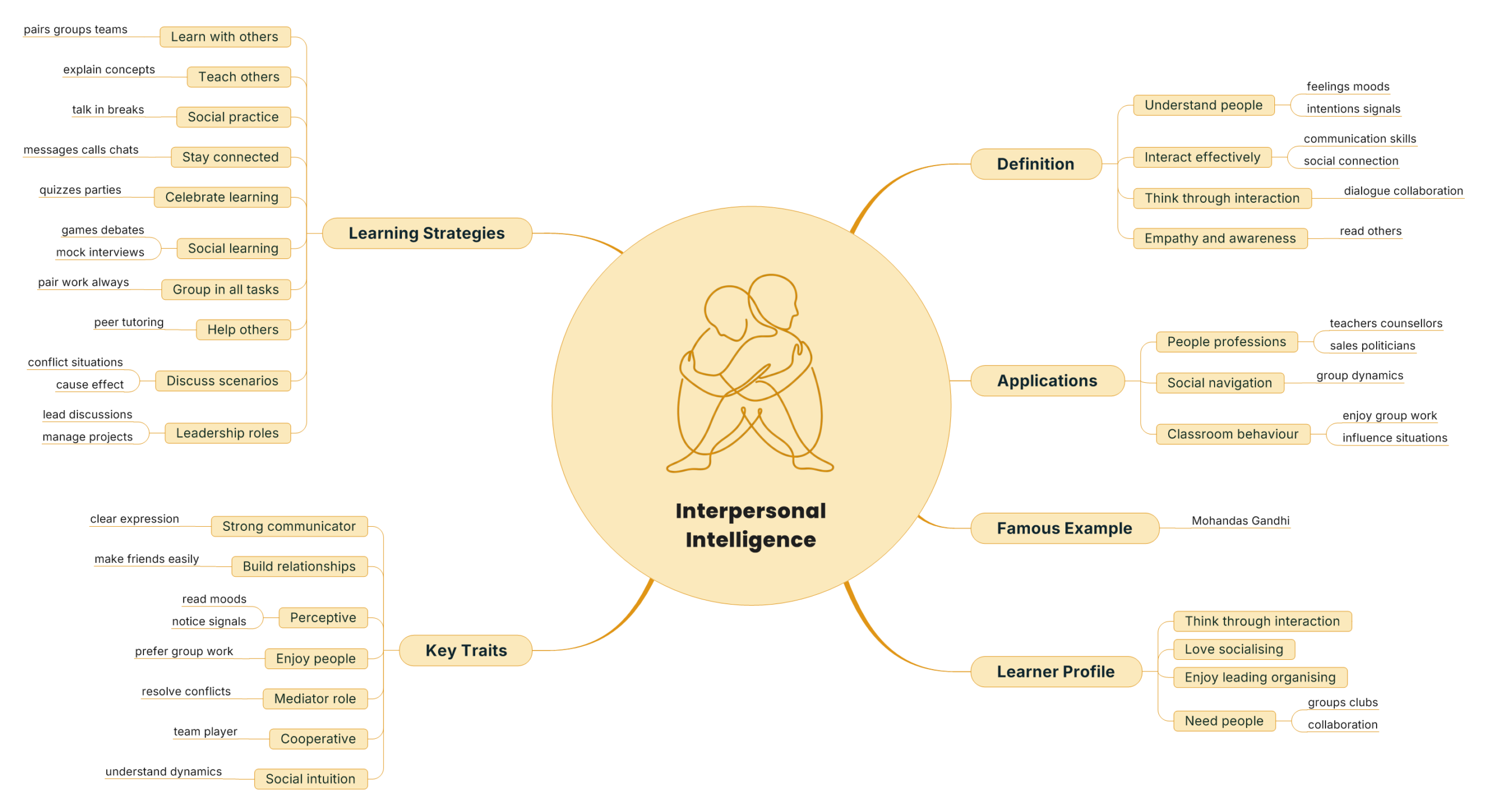

INTERPERSONAL
INTELLIGENCE
1. What Is It?
Interpersonal intelligence is the ability to understand, interact with, and relate effectively to other people. People with strong interpersonal intelligence think through their interactions with others — they generate ideas and find solutions through dialogue, collaboration, and social connection.
This intelligence enables individuals to recognise and respond to the feelings, moods, and intentions of those around them. It is the intelligence of empathy, communication, and social skill. It is well developed in teachers, counsellors, salespeople, politicians, psychologists, and community leaders. In the classroom, students with strong interpersonal intelligence thrive on group work, notice and respond to the moods of their classmates, and skilfully navigate social situations — sometimes even persuading the teacher to give them extra time for an assignment.
Famous representative: Mohandas Gandhi
2. Key Traits
A person with strong interpersonal intelligence is a natural communicator and a skilled negotiator. They make friends easily and build relationships with a wide range of people. They are perceptive — they can read others’ intentions and moods, often picking up on things that others miss. They enjoy being around people, prefer group activities over working alone, and often take on the role of mediator in disagreements. They cooperate well and enjoy collaborative tasks. They understand the dynamics of social situations intuitively and can sometimes be subtly persuasive.
At a glance, interpersonal learners think through their interactions with others. They love leading, organising, mediating, and socialising. They need friends, group activities, social gatherings, clubs, mentoring opportunities, and collaborative learning environments.
How to Use It in the Learning Process
Interpersonal intelligence is a natural asset in the English classroom, especially in communicative and task-based approaches. Here are practical strategies:
- Learn with others. Study in pairs, small groups, or teams whenever possible. Collaborative learning is where interpersonal learners shine.
- Share your knowledge. Explaining a grammar rule or a new word to a classmate deepens your own understanding and builds fluency at the same time.
- Network and socialise during breaks. Use break time for informal English conversations. The social dimension of language learning is just as important as the formal one.
- Keep in touch with your teacher and fellow students outside the classroom. Phone calls, messages, social media exchanges, or video chats in English all count as valuable practice.
- Celebrate what you have learned. Organise small gatherings, quizzes, or “language parties” where achievements are shared and recognised. Interpersonal learners are energised by communal celebration.
- Turn learning into a social experience. Play team-based language games, hold discussions, organise debates, or run mock interviews.
- Include interpersonal interaction in every subject area. Whatever the topic — grammar, vocabulary, reading, or writing — find a way to involve pair or group work.
- Learn by helping others. Tutoring a less advanced student or supporting a classmate with a difficult task reinforces your own learning.
- Practise conflict resolution and cause-and-effect analysis in English. Discussing real or hypothetical scenarios in pairs or groups develops both language and social intelligence.
- Take on leadership roles in group activities — chair a discussion, organise a project, or manage a team task. These roles demand and develop both language and interpersonal skills.