
INTRAPERSONAL
INTELLIGENCE
1. What Is It?
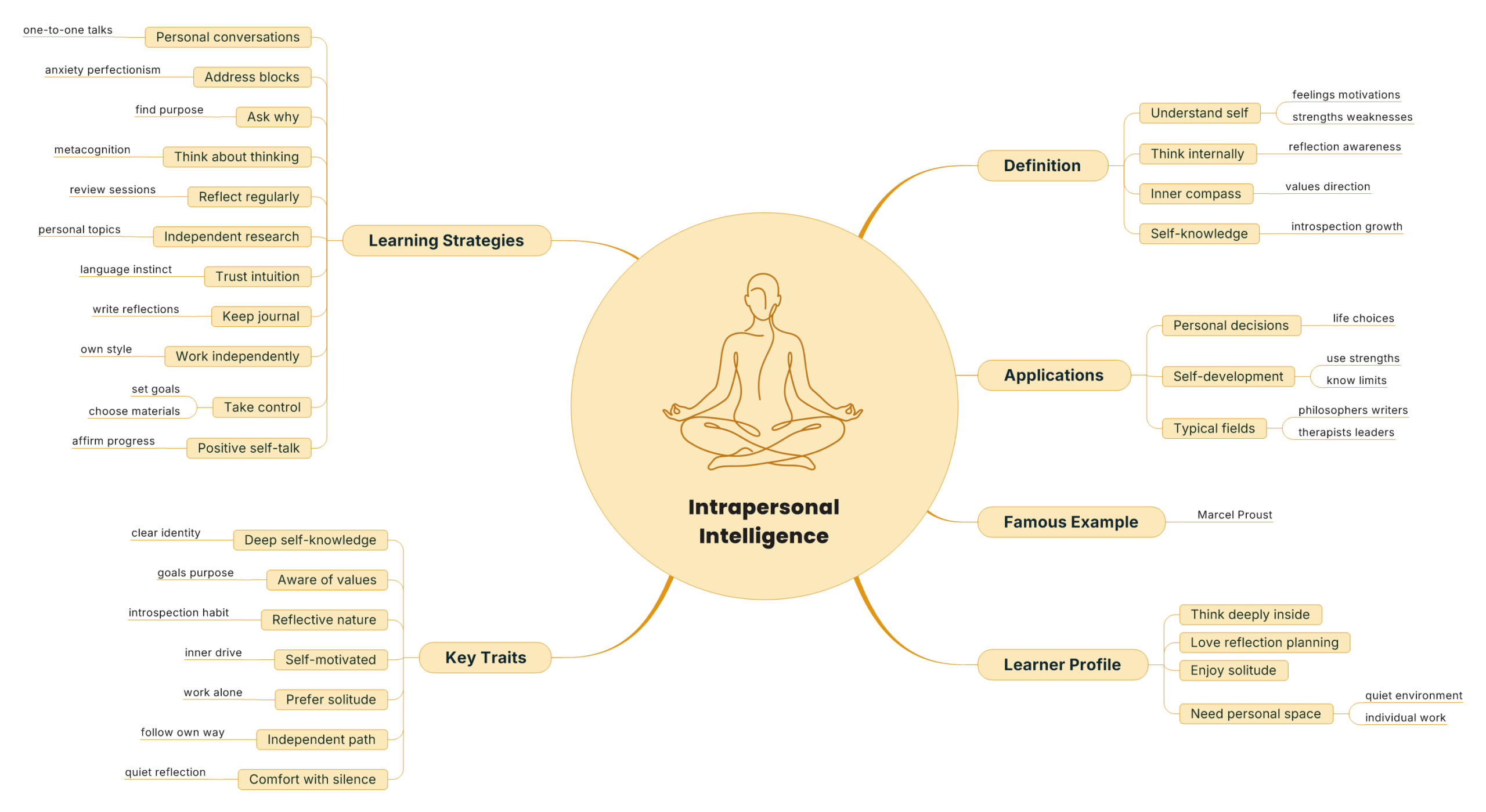
Intrapersonal intelligence is the ability to understand oneself — one’s own feelings, motivations, strengths, and weaknesses. People with strong intrapersonal intelligence think deeply within themselves. They are reflective, self-aware, and guided by a strong inner compass.
This intelligence helps individuals build accurate mental models of themselves and use those models to make thoughtful decisions about their lives. It is the intelligence of self-knowledge, introspection, and personal growth. Although it can be difficult to observe and assess from the outside, evidence of strong intrapersonal intelligence can be found in how well people capitalise on their strengths, how aware they are of their limitations, and how thoughtful they are about the choices they make. It is well developed in philosophers, writers, therapists, and spiritual leaders.
Famous representative: Marcel Proust
2. Key Traits
A person with strong intrapersonal intelligence has a deep knowledge of themselves. They are attuned to their own values, feelings, and life goals. They are fully aware of both their strengths and their weaknesses, and they use this self-awareness to guide their actions. They are intuitive, self-motivated, and reflective. They tend to be private by nature and may prefer working alone to working in groups. They often feel a need to be different from the majority and to follow their own path. They have a well-developed sense of purpose and are comfortable spending time in quiet reflection.
At a glance, intrapersonal learners think deeply within themselves. They love setting goals, meditating, dreaming, planning, and reflecting in silence. They need private spaces, time alone, and personal projects.
How to Use It in the Learning Process
Intrapersonal intelligence is a quiet but powerful force in language learning. For reflective learners, the key is to create space for personal engagement with the material. Here are practical strategies:
- Have personal, heartfelt conversations — in English. One-on-one discussions on topics that matter to you provide both meaningful practice and emotional engagement.
- Use personal development activities to overcome blocks to learning. If anxiety, perfectionism, or self-doubt is holding you back, address it directly — reflective learners respond well to metacognitive approaches.
- Ask yourself why. Always look for the reasons behind what you are learning. Understanding the purpose of an activity makes it more meaningful and memorable.
- Think about your thinking. Practise metacognition — reflect on how you learn best, which strategies work for you, and where you struggle. This awareness allows you to fine-tune your approach.
- Allocate time for reflection. After each lesson or study session, take a few minutes to review what you have learned, what was challenging, and what you want to explore further.
- Conduct independent research. Choose a topic that interests you personally and explore it in English — read articles, watch videos, and write your own reflections.
- Listen to your intuition. If something feels right or wrong about a sentence, a pronunciation, or a word choice, pay attention to that feeling. It is often a sign that your language instinct is developing.
- Keep a learning journal or diary in English. Write about your experiences, your feelings about the learning process, and your goals. This is both a reflective practice and a writing exercise.
- Allow yourself to be different from the group. Not every learner needs the same approach. If you prefer to work quietly on your own while others are discussing in groups, that is a legitimate and effective learning style.
- Take control of your own learning. Set personal goals, choose your own reading materials, and decide your own pace. Autonomy is deeply motivating for intrapersonal learners.
- Practise personal affirmation. Recognise and celebrate your progress, even the small steps. Positive self-talk in English is itself a form of language practice.