
NATURALISTIC
INTELLIGENCE
1. What Is It?
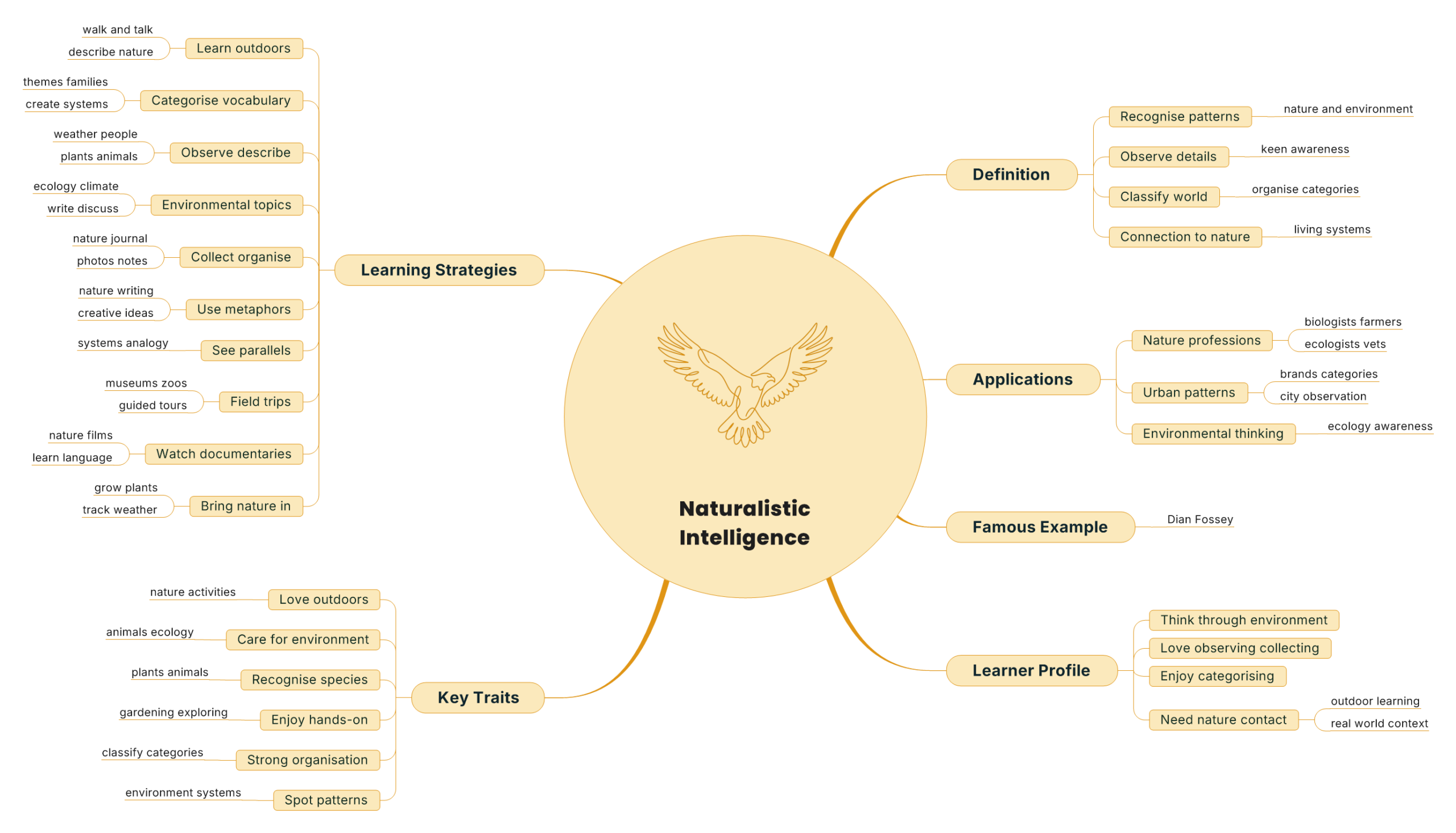
Naturalistic intelligence is the ability to recognise, categorise, and understand patterns in the natural world — and, by extension, in any environment. People with strong naturalistic intelligence are keenly observant. They notice details that others miss, classify and organise what they see, and feel a deep connection to the living world around them.
This is the eighth and final intelligence identified by Howard Gardner, and it refers to the capacity to understand the world of plants and animals, to recognise their diversity, and to appreciate their needs. It is well developed in biologists, farmers, gardeners, veterinarians, botanists, ecologists, and oceanographers. However, naturalistic intelligence is not limited to the countryside — Gardner himself noted that in our modern consumer society, this intelligence also manifests as the ability to discriminate among large numbers of categories, such as car models, shoe brands, or product types. People raised in urban environments can develop their naturalistic abilities by observing, classifying, and making sense of the patterns in their surroundings.
Naturalistic learners understand the world best through their environment. They enjoy being outdoors, care about ecology and animals, and can easily identify and remember different species and natural phenomena. They often enjoy gardening and “getting their hands dirty.” They tend to organise things into hierarchies and categories — a skill that transfers beautifully to language learning.
Famous representative: Dian Fossey
2. Key Traits
A person with strong naturalistic intelligence enjoys working and spending time outdoors. They believe strongly in the importance of nature, ecology, and the protection of animals. They understand and easily remember different species and natural phenomena in their environment. They often enjoy gardening, caring for animals, or exploring natural spaces. They have a natural tendency to classify, categorise, and organise — whether it is types of birds, kinds of rocks, or brands of trainers. In urban settings, they may channel this intelligence into recognising patterns in their surroundings, from architecture to street life.
At a glance, naturalistic learners think through their connection to the environment. They love observing, collecting, classifying, and spending time in nature. They need outdoor experiences, contact with the natural world, and opportunities to explore and categorise.
How to Use It in the Learning Process
Naturalistic intelligence may seem like an unlikely partner for English language learning, but its emphasis on observation, classification, and pattern recognition makes it surprisingly useful. Here are practical strategies:
- Take learning outdoors. Hold an English conversation while walking in a park, describe what you see in nature, or do a vocabulary-building exercise in a garden or woodland setting.
- Classify and categorise vocabulary. Group new words by theme, by word family, by sound pattern, or by any other system that appeals to your organising instinct. Creating your own taxonomy of English vocabulary is a powerful memorisation tool.
- Observe and describe. Practise English by describing what you see around you in detail — the weather, the plants, the animals, the people, the architecture. Naturalistic learners are naturally good at detailed observation, and turning those observations into English is excellent practice.
- Connect language learning to environmental topics. Read articles about ecology, climate change, or wildlife conservation in English. Write about nature. Discuss environmental issues.
- Collect and organise. Create a nature journal in English — press leaves and flowers and label them, photograph wildlife and write captions, or keep a weather diary with daily descriptions.
- Use nature as a source of metaphor and creative writing. The natural world is endlessly rich with material for descriptive writing, poetry, and storytelling in English.
- Draw parallels between natural systems and language systems. Just as ecosystems have structures, hierarchies, and interdependencies, so does language. Naturalistic learners often respond well to this kind of analogy.
- Explore English through field trips and excursions to museums, botanical gardens, zoos, or nature reserves — ideally with English-language guides or audio tours.
- Watch nature documentaries in English. The combination of stunning visuals and clear narration makes these an ideal learning resource for naturalistic learners.
- Bring nature into the classroom. Even simple activities — growing a plant and describing its progress in English, or observing the weather each day and recording it — can engage naturalistic intelligence in the service of language learning.